The Federal Reserve deleted the six-transfers-a-month cap on savings accounts on April 24, 2020, after reserve requirement ratios were cut to zero, and has stated it has no plans to re-impose transfer limits. Your bank is still allowed to enforce one anyway. That single piece of fine print decides whether you can run envelope budgeting inside savings sub-accounts, or whether you need cash, a checking account, or an app that tracks envelopes without actually moving money between them.
This article is the mechanics: what to envelope, how big each envelope should be, what happens when one runs dry, and how the month ends. Whether the method is worth adopting at all is a separate argument, made in envelope budgeting.
Fixed bills should not get an envelope
The most common setup mistake is enveloping everything. An envelope is a spending limit you enforce in the moment, at the point of purchase. A fixed bill has no moment — the amount is already decided and the date is already known. Putting rent in an envelope does not change what you pay for rent.
| Category type | Envelope it? | Why |
|---|---|---|
| Rent or mortgage, insurance premiums, loan payments | No | Amount and date are fixed. Nothing to decide at the register. |
| Utilities, phone, internet | No | Variable, but you cannot change the amount after the fact. Track them, do not envelope them. |
| Subscriptions | No | Cancel or keep — a monthly cap does nothing. See the subscription audit. |
| Groceries, gas, dining, household goods, personal care, pets, entertainment, clothing | Yes | Many small decisions, each of which a running balance can change. |
| Annual and irregular costs | No — sinking funds instead | Covered below. |
| Debt payoff above the minimum | No | It is a transfer, not spending. See avalanche vs snowball. |
The practical test: if seeing $12 left would change what you do in the next hour, it is an envelope. If not, it is a bill.
Size each envelope from statements, not from intentions
Pull at least three months of card and bank statements, six if you have them, and sort every transaction into your envelope categories. Then take the median month, not the average. One holiday month or one big vet bill drags the mean upward and hides how a normal month behaves.
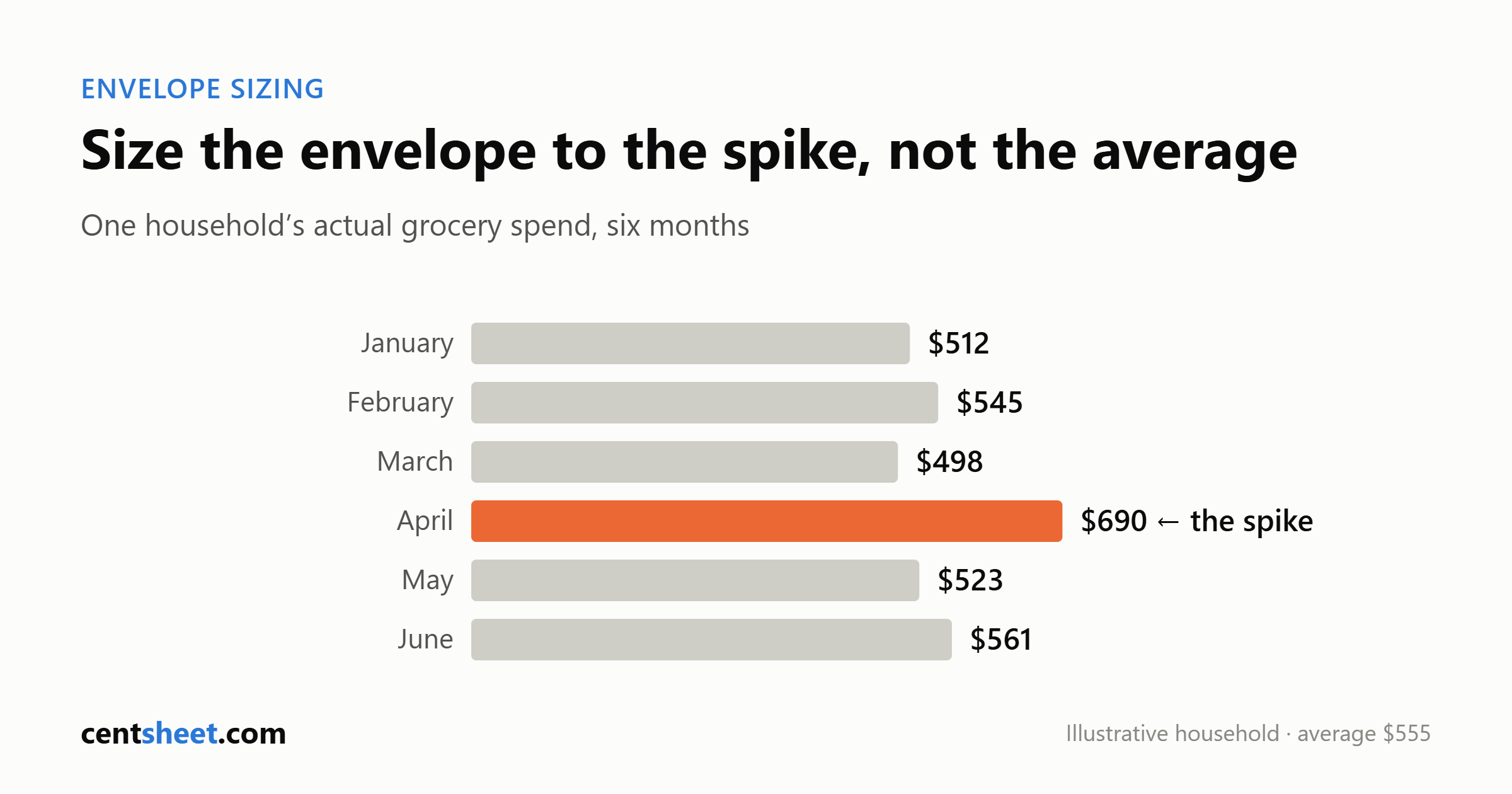
Here is six months of grocery spending. These are illustrative figures, chosen to be arithmetically clean — not survey data.
| Month | Grocery spend |
|---|---|
| January | $512 |
| February | $545 |
| March | $498 |
| April | $690 |
| May | $523 |
| June | $561 |
| Median | $534 |
| Mean | $555 |
| Highest month | $690 |
Our calculation, on those illustrative numbers: an envelope set at the median of $534 would have been overspent in three of the six months; set at the mean of $555, in two of six. The worst month ran $156 over the median. Neither number is right. Any single figure will be breached regularly, and the system needs an answer for that rather than treating it as failure.
There is a second failure mode that budgeting advice almost never mentions. Heath and Soll’s 1996 study of mental budgeting in the Journal of Consumer Research found that because budgets cannot perfectly anticipate consumption opportunities, people earmark too much or too little for a category — producing overconsumption or underconsumption. Three of their studies suggested budgeting may lead to underconsumption, with larger effects for purchases that are highly typical of their category. An envelope set too small does not only cause overspending — it can stop you buying things you had the money for. Set envelopes at what you actually spend, then adjust.
A worked example
One month for a household with $4,200 in take-home pay. Every figure is a CentSheet illustration chosen to add up cleanly — not a benchmark and not a claim about typical US spending.
| Line | Amount | Enveloped? |
|---|---|---|
| Rent | $1,350 | No — fixed |
| Renters insurance | $18 | No — fixed |
| Utilities | $145 | No |
| Phone and internet | $115 | No |
| Car payment | $310 | No — fixed |
| Car insurance | $132 | No — fixed |
| Student loan | $180 | No — fixed |
| Subscriptions | $34 | No |
| Fixed subtotal | $2,284 | |
| Sinking funds (car upkeep, gifts, medical, memberships) | $200 | No — separate account |
| Savings and emergency fund | $350 | No |
| Groceries | $560 | Yes |
| Gas and transit | $150 | Yes |
| Dining out and takeout | $180 | Yes |
| Household and personal care | $95 | Yes |
| Pet supplies | $45 | Yes |
| Clothing | $60 | Yes |
| Entertainment and hobbies | $85 | Yes |
| Buffer (unassigned) | $191 | Yes |
| Envelope subtotal | $1,366 | |
| Total | $4,200 |
Eight envelopes, not twenty. The buffer envelope is the load-bearing part: it is what absorbs the month that runs $156 over on groceries without forcing you to raid the car-upkeep money. If you assign every dollar to a named category with nothing left over — a strict zero-based budget — build the buffer in as a named category rather than pretending it is not needed.
If your income varies month to month, size envelopes off your lowest recent month rather than your median, and read budgeting on a variable income before you set the numbers.
The borrowing rule
Every envelope system runs dry somewhere. The rule that keeps it functioning has three parts.
1. Borrowing must name a source. Money comes out of a specific envelope — “$40 from entertainment to groceries” — never out of “the account”. An unnamed transfer is just overspending with extra steps. 2. It must be written down at the time. A transfer you record next week is a transfer you will not record. 3. Two envelopes are off-limits as sources: the sinking funds, and anything holding a fixed bill. Borrowing from next month’s car registration to pay for this month’s takeout converts a small overspend into a missed obligation.
If the same envelope needs a bailout three months running, the envelope is mis-sized. Re-cut it from the last three months of actual spending and take the difference from somewhere else — that is a budgeting decision, not a discipline problem. Grocery budget math covers the category that most often turns out to be under-funded.
Annual costs belong in sinking funds, not envelopes
Car registration, insurance paid in six-month blocks, the vet, holidays, the annual professional membership. These break envelope budgeting because they are large, infrequent, and arrive with no relationship to the calendar month you are in.
The mechanic: divide each annual cost by twelve, sum those, and move that amount to a separate deposit account on payday. It never enters the envelope system. Our sinking funds guide works through the sizing.
One warning on where that money sits. Series I savings bonds are often pitched for medium-term savings; they cannot be redeemed at all for the first 12 months. Cash out before five years and you forfeit the last three months of interest. Money you may need for a car repair in March does not belong there. And as of January 1, 2025 you can no longer buy paper Series I bonds with a tax refund — Treasury cited cost, uptake under 1% of Series I purchases, and theft and mail-delay risk. The “$5,000 extra via your refund” tip is still all over the internet and is now simply false.
Where the money physically sits
Three options. The trade-offs are not the ones usually cited.
Physical cash. Withdraw the envelope total, split it, spend it down. The cost is that cash earns nothing and is not covered by deposit insurance once it leaves the bank — FDIC coverage attaches to deposits at an insured institution, and FDIC explicitly lists safe deposit boxes and their contents among the things it does not insure. Whether your renters or homeowners policy covers cash, and up to what limit, is a question for your own declarations page — we have no sourced figure for it. See renters insurance.
The yield you give up is smaller than it sounds. FDIC’s national average deposit rates, published July 20, 2026 and reflecting data from the last business day of the prior month, were:
| Product | FDIC national average |
|---|---|
| Savings | 0.38% |
| Money market deposit account | 0.65% |
| Interest checking | 0.07% |
Our calculation, with assumptions stated: envelope cash spends down over the month, so on a $1,366 monthly envelope total the average balance might be roughly half that, about $683. Held for a year at 0.65%, simple interest, rate flat, that is about $4.44. At the 0.38% savings average, about $2.60. The interest cost of running physical cash envelopes is a few dollars a year. Argue against cash on convenience, safety, or refunds — not on yield.
Do not confuse FDIC’s separate 4.38% “national rate cap” with any of the above. That is a supervisory ceiling applied to less-than-well-capitalized institutions, not a rate you can earn.
Savings sub-accounts. Many banks let you split one savings account into named buckets. This is the cleanest digital version of the method. Two things to check first. The Fed’s April 24, 2020 interim final rule deleted the six-per-month limit on convenient transfers from the definition of a savings deposit, and the Fed has said it has no plans to re-impose transfer limits — but the rule permits institutions to suspend enforcement, it does not require them to. Your bank may still cap transfers and charge excess-transfer fees under its account agreement. We could not verify the currently codified text of 12 CFR 204.2(d) directly: both federalregister.gov and ecfr.gov redirected our requests to an anti-bot page. Read your own account agreement, not any article, including this one.
Second: sub-accounts do not multiply deposit insurance. FDIC coverage is $250,000 per depositor, per insured bank, for each account ownership category. Twelve buckets at one bank is still one depositor at one bank. At a credit union the equivalent cover is the National Credit Union Share Insurance Fund, not FDIC — also $250,000, also backed by the full faith and credit of the United States, also automatic, but a different agency with its own category rules.
Checking plus a ledger. One account, envelopes tracked in an app or spreadsheet, no money moved. Fewest transfer problems, weakest enforcement, since the balance at the register is the whole account.
One honest limit: we cannot tell you the best available savings rate. In the first week of August 2026 the aggregators disagreed sharply: Motley Fool listed “up to 4.50% APY” on August 3, Yahoo Finance “up to 4.15%” on August 5, and CNBC Select and NerdWallet both “up to 4.21%” — a 35-basis-point spread in the same week, and we verified none of them against the issuing institution’s own rate disclosure. High-yield savings rates are variable by design and change without notice. Check the bank’s own page on the day you open, and see HYSA vs CD vs T-bills for how the categories differ.
The end-of-month reset
Decide the reset rule per envelope before the first month starts, not on the 31st.
| Envelope | Reset | Why |
|---|---|---|
| Groceries | Sweep leftovers | Spending restarts monthly. A large recurring carryover means the envelope is oversized — re-cut it. |
| Dining, entertainment | Sweep | Same logic. Rolling these over quietly inflates the category. |
| Clothing, household goods | Roll over, capped | Purchases are lumpy and seasonal. Cap the rollover at two months’ worth so it does not become a slush fund. |
| Car upkeep, medical | Roll over | Or better, move them out of envelopes and into sinking funds. |
| Buffer | Sweep to a savings goal | Otherwise it silently becomes spending money. |
“Sweep” means the leftover goes somewhere with a name — emergency fund, a sinking fund, extra debt payment. Leftover money with no destination gets spent by default, and the month looks like a success while nothing was saved.
What to actually do
1. Sort three to six months of statements into categories. Do this before choosing envelope amounts. 2. Envelope only variable, discretionary, frequent spending. Leave fixed bills, subscriptions, and debt payments out of the system entirely. 3. Set each envelope at the median month, not the mean and not an aspiration. 4. Build a named buffer envelope. Without it, every over-budget month becomes a raid on something important. 5. Write the borrowing rule down: transfers name a source envelope, get logged immediately, and never come from sinking funds or bill money. 6. Move annual costs to sinking funds in a separate deposit account on payday, before the envelopes are filled. 7. Set the reset rule — sweep or roll over — for each envelope in advance, and re-cut any envelope that needed bailing out three months running.
The setup is a couple of hours with statements and a spreadsheet. The recurring cost is a few minutes a week. If it is taking longer than that, you have too many envelopes.
CentSheet publishes educational content, not personalized financial advice, and nothing here is tax advice. Rates and deposit insurance rules cited are dated at the point of use and change without notice.
Get the CentSheet Money Brief
Email me CentSheet weekly: practical money decisions, new calculators, and useful worksheets. Unsubscribe anytime.