The question is always “can I afford the rent?” It’s the wrong question, and it’s why so many first apartments end in a move back home.
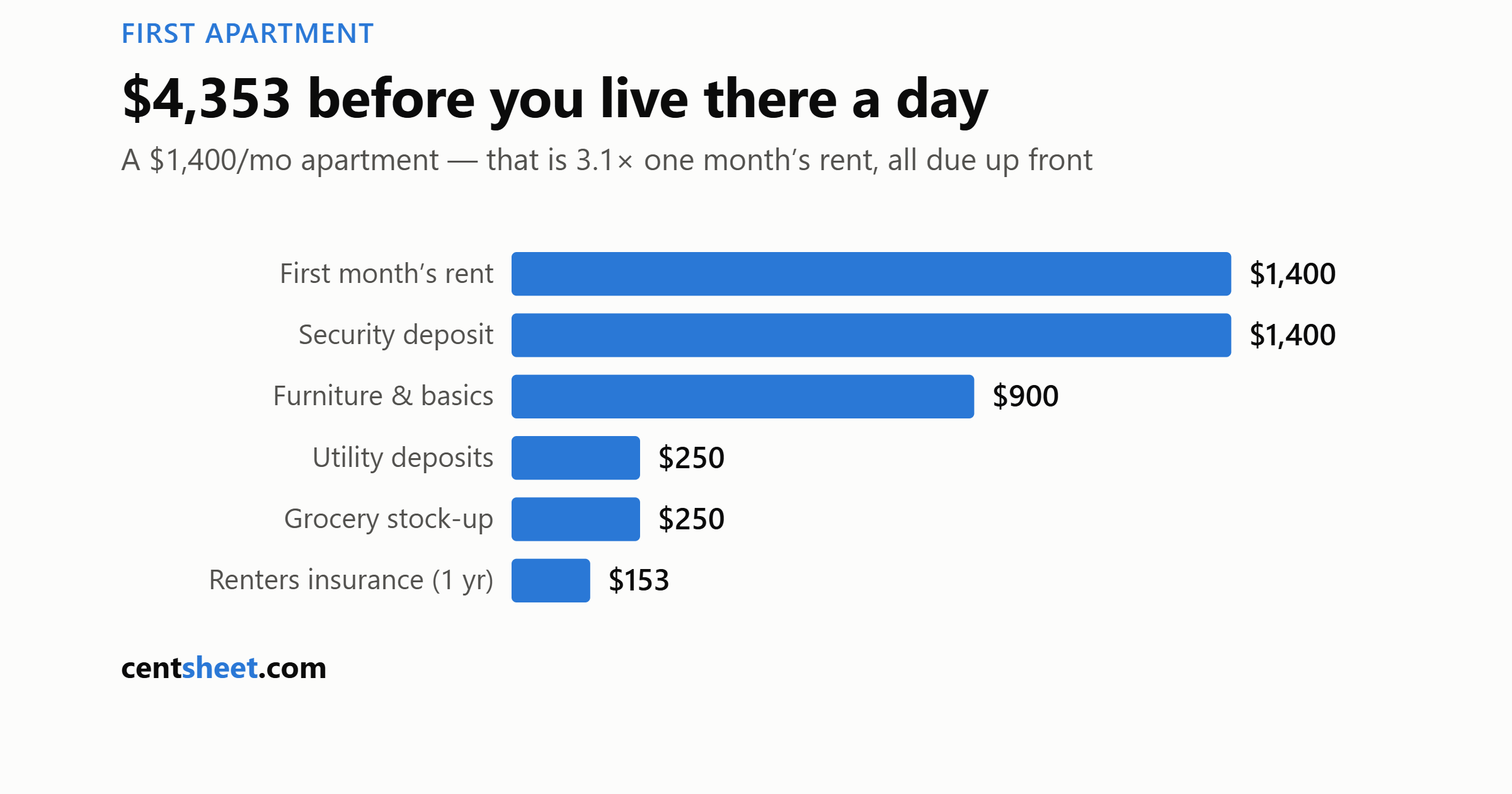
Rent is the recurring cost. The barrier is the startup cost — the money that leaves before you’ve slept there once. On a $1,400 apartment it runs about $4,353, roughly three times one month’s rent.
The startup bill, itemized
| Line | Cost |
|---|---|
| First month’s rent | $1,400 |
| Security deposit | $1,400 |
| Utility deposits and connection fees | $250 |
| Renters insurance, first year | $153 |
| Furniture and household basics | $900 |
| Initial grocery and supply stock-up | $250 |
| Total before you’ve lived there a day | $4,353 |
Landlords sometimes want last month’s rent too, which pushes it past $5,700. The multiple is the number to remember: plan for 3× rent, hope for 2.5×.
Then the monthly number, which is also not the rent
Rent is roughly 80% of what an apartment costs each month. The rest — covered in detail here — is electricity, internet, insurance, water, parking, laundry. On a $1,400 apartment the real all-in figure lands near $1,733.
So the honest monthly commitment isn’t $1,400. It’s about $1,750, before you’ve eaten anything.
The income floor
The common landlord screen is gross annual income of 40× the monthly rent — $56,000 for a $1,400 apartment. Many will also accept a co-signer or extra deposit instead.
But qualifying and thriving are different tests. Run it against the 50/30/20 diagnostic: at $1,750 all-in, housing fits the “needs under half” rule only if take-home is roughly $3,500/month. Below that, you’re not failing at budgeting — the arithmetic is simply tight, and the honest levers are a roommate, a cheaper unit, or more income.
What actually makes the first move survivable
Have the startup number saved before signing. Not “mostly.” All of it. Financing a security deposit at credit-card rates starts your independence with 24% APR working against you.
Furnish slowly and secondhand. The $900 line assumes a bed, somewhere to sit, and kitchen basics — not a furnished apartment. Marketplace, buy-nothing groups, and patience beat a furniture loan by a wide margin. You do not need a sofa in week one.
Keep a starter emergency fund separate. Spending your entire cushion on the move means the first car repair goes on a card. $1,000 untouched, minimum.
Read the lease for the money clauses: what the deposit covers, the notice period, the early-termination penalty, and whether utilities are included. These determine your real cost more than the headline rent does.
The uncomfortable summary
The first apartment costs roughly a full month’s take-home pay at a $56,000 income — or about a quarter of a year’s rent — before you own a single piece of furniture. That’s not a reason not to move out; it’s a reason to know the number in advance, save it deliberately as a sinking fund, and sign the lease with the money already in the account.
The people for whom this goes badly are almost never the ones who couldn’t afford the rent. They’re the ones who only budgeted for the rent.
CentSheet publishes educational content, not personalized financial advice. Figures are illustrative; deposits, utility costs and income requirements vary widely by market and landlord.
Get the CentSheet Money Brief
Email me CentSheet weekly: practical money decisions, new calculators, and useful worksheets. Unsubscribe anytime.