The strongest evidence that people spend less when they pay in cash is a 2024 meta-analysis covering 392 effect sizes from 71 published and unpublished papers. It found the effect is real. It also found it is small, and that it has weakened over time. That is the actual foundation under envelope budgeting, and it is thinner than the method’s popularity suggests.
Envelope budgeting means committing a fixed amount to each category up front and stopping when it is gone. This article is about whether that works. For setup mechanics, see how envelope budgeting works.
Nobody can tell you where the method came from
We looked specifically for a documented origin: an inventor, a founding date, a first published description. We did not find one.
Every version of the folk history — the oldest budgeting system still in service, the one your great-grandmother ran the household on, a method that “dates back decades” — traces to content-marketing pages at banks and budgeting apps, none of which cite a source. That does not make it wrong. It means nobody publishes a citation, and we will not invent one. The mechanic works without a pedigree: partition the money before you spend it, and let the partition enforce the limit instead of your judgment at the register.
What the cash-versus-card research actually found
Three papers carry the weight, and together they say less than either side claims.
| Paper | Journal and year | Scope | Finding |
|---|---|---|---|
| Prelec & Simester, “Always Leave Home Without It” | Marketing Letters vol. 12, pp. 5-12, 2001 | Auction bids for basketball tickets | Cards raised willingness to pay; magnitude unverified by us |
| Heath & Soll, “Mental Budgeting and Consumer Decisions” | Journal of Consumer Research vol. 23, pp. 40-52, 1996 | Three studies of category budgeting | Budgets produce overconsumption or underconsumption |
| Schomburgk, Belli & Hoffmann, “Less cash, more splash?” | Journal of Retailing vol. 100, pp. 382-403, 2024 | 392 effect sizes, 71 papers, 17 countries, 11,000+ participants | Cashless effect small but significant; weakened over time |
The 2001 paper is the one everybody cites. We verified the citation against its DOI, but the full text is paywalled and the abstract elided, so we never saw the effect size at source. The very large percentage usually attached to it reached us only through search-engine summaries, so we are not printing it — and it is a 25-year-old result from before near-universal card and mobile payment.
The 2024 meta-analysis is the better answer. It pooled 392 effect sizes from 71 published and unpublished papers across 17 countries and more than 11,000 unique participants. The cashless effect survives — it is statistically significant — but it is small, and its moderators matter: stronger for conspicuous consumption, weaker for pro-social spending, stronger during economic growth, weakening over time. It also found cashless payment does not necessarily produce larger tips or donations.
So the honest summary is not that the credit-card effect was debunked. It is smaller than early headline studies suggested and appears to be shrinking as cashless payment becomes the default. A large replication by Bechler, Catapano, Huang and Urminsky is conditionally accepted at the Journal of Consumer Research for 2026; its results are not public, so we will not tell you what it found. Stanford GSB lists it as “A Mega-replication of the Effect of Cash versus Card Payment on Pain of Paying”; Urminsky’s faculty page calls it “The Pain of Paying Effect Revisited.” Same paper, two titles.
And none of it tests envelope budgeting. The literature asks whether people spend more with a card than with cash in one transaction. Envelope budgeting asks whether partitioning money into labeled categories in advance improves what you keep. We found no study on that, so anyone telling you the research proves cash stuffing works is upgrading one finding into a different claim.
The constraint is the mechanism, and it misfires both ways
The most useful paper for envelope users has nothing to do with cash. Heath and Soll’s 1996 work on mental budgeting found that because a budget cannot anticipate the consumption opportunities you will actually face, people earmark too much or too little. Their three studies suggested budgeting can lead to underconsumption, with larger effects for purchases highly typical of their category. (The full text was not extractable in our environment; this comes from bibliographic records of the abstract.)
That is a fair account of what an envelope does. It moves the decision away from the moment of purchase, which is the point, and it means a category you sized badly stays badly sized until you fix it. Someone who underfunds groceries and eats worse in the last week of the month is experiencing the method working as designed.
Which is the argument for pairing envelopes with zero-based budgeting, where categories are re-derived monthly rather than inherited. Size them from your last three months of actual spending, not a template — our budget calculator is a starting point, and sinking funds absorb the irregular costs that wreck a monthly envelope.
Three ways to run envelopes without cash
| Implementation | What stops the spend | Deposit insurance | Main drawback |
|---|---|---|---|
| One account per category | A declined transaction | FDIC or NCUA, per ownership category | Insurance and transfer limits surprise people |
| Per-category debit or prepaid cards | A declined transaction | Only if the product qualifies | Only as good as the underlying account |
| App-based virtual envelopes | A notification | Whatever your one real account has | Nothing physically stops the swipe |
Multiple accounts
A separate account per category is the closest digital analogue to a physical envelope: an empty account declines the card. Two things people get wrong.
First, splitting one balance across six accounts at the same bank does not multiply your insurance. FDIC coverage is $250,000 per depositor, per insured bank, for each account ownership category — not per account. Six single-ownership accounts at one bank share one $250,000 limit. At a credit union the equivalent is the National Credit Union Share Insurance Fund — also $250,000, also backed by the full faith and credit of the United States, established by Congress in 1970. It is NCUA, not FDIC, and the category fine print differs.
Second, the six-transfers-per-month rule. The Federal Reserve’s April 24, 2020 interim final rule deleted the six-per-month limit on convenient transfers from the savings-deposit definition, after reserve requirement ratios were reduced to zero, and the Board has said it does not plan to re-impose transfer limits. But the rule permits banks to suspend enforcement — it does not require them to. Yours may still cap transfers and charge excess-transfer fees if its account agreement says so. We could not verify the currently codified text; the Federal Register and eCFR both blocked our requests. Read your agreement, not a headline.
The practical risk is overdraft: six thin balances fail more often than one thick one, and overdraft protection is not one product — the defaults differ.
Per-category cards
A card assigned to one category enforces the envelope at the terminal, but it is only as good as the account behind it. FDIC’s list of insured products covers checking, savings, money market deposit accounts, CDs and qualifying prepaid cards. We did not verify what qualifying requires, so confirm insurance with the provider rather than assuming a card balance is a deposit.
App envelopes
In most budgeting apps the envelope is a label sitting on one real balance. Nothing declines. The constraint is a number turning red, which is a different thing from a spent-out envelope. It may still work for you; there is no evidence either way. If you are paying for three overlapping money apps, start with a subscription audit.
Where the money sits, and why we are not printing a top rate
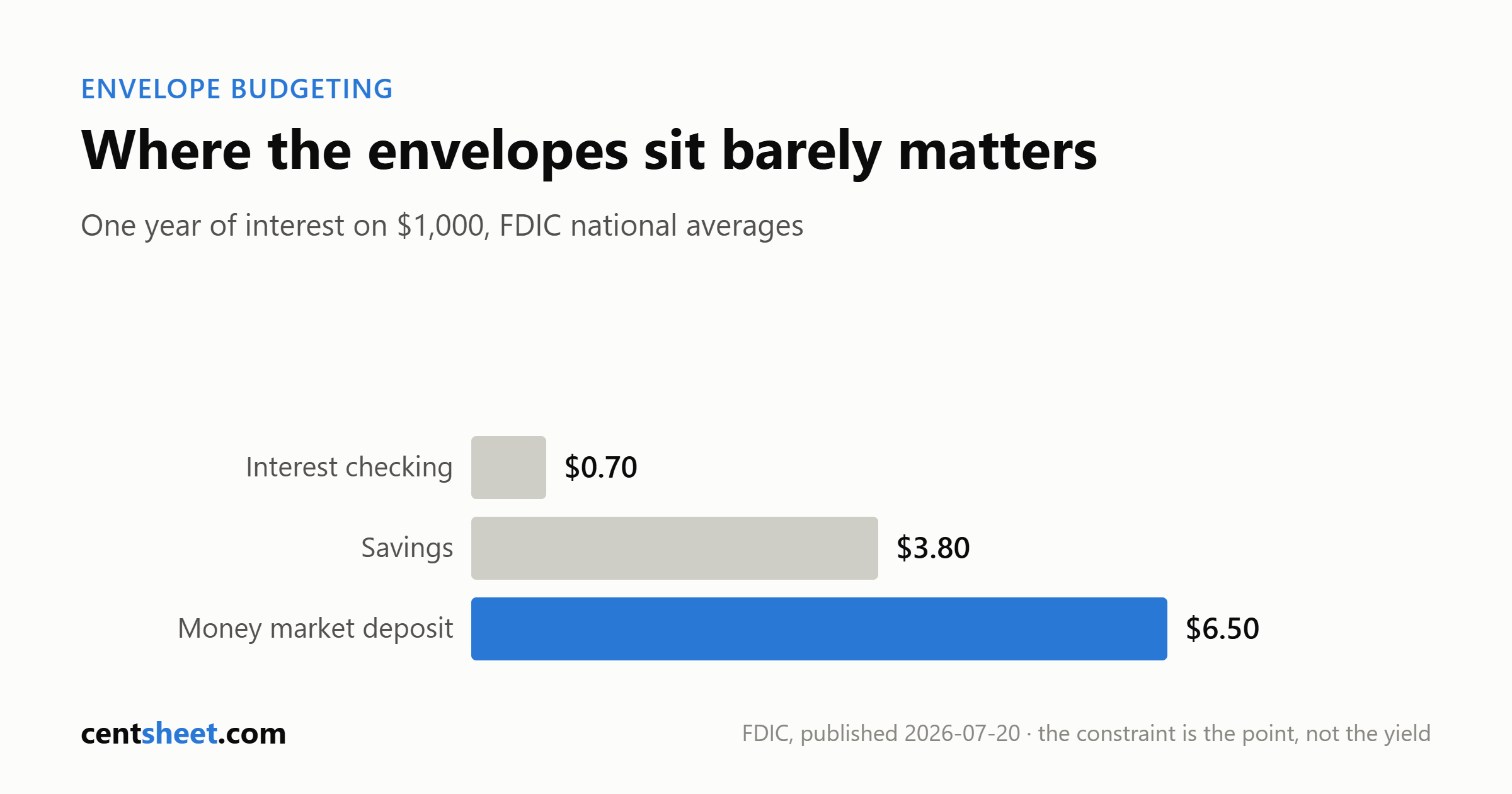
FDIC publishes deposit-weighted national averages across insured institutions and credit unions reporting data, on the third Monday of each month. The most recent set was published July 20, 2026 and, per FDIC’s methodology, reflects the last business day of the prior month — roughly June 30, 2026.
| Product | FDIC national average (published 2026-07-20) | One year on $1,000, CentSheet calculation |
|---|---|---|
| Money market deposit account | 0.65% | $6.50 |
| Savings | 0.38% | $3.80 |
| Interest checking | 0.07% | $0.70 |
| Cash in a physical envelope | none | $0 |
Those dollar figures are our arithmetic, not FDIC’s: simple annual interest on a flat $1,000, no compounding, no fees or minimum-balance effects, rate held constant for a year.
You can do considerably better than the average, and we are deliberately not saying how much better. In the first week of August 2026 the rate aggregators disagreed with each other by 35 basis points or more: one said up to 4.50%, another 4.15%, two said 4.21%, another 4.20% with a $5,000 minimum, and one advertised “up to 10.00%” — almost certainly a capped rewards-checking product rather than a comparable savings APY. We fetched no bank’s own disclosure, so none of those is verified at source, and these rates are variable by design. Our HYSA vs. CD vs. T-bills comparison covers the trade-offs without naming a winner.
Cash stuffing is partly a video format
The binders, the color-coded sleeves, the sound of twenties counted into labeled pockets — that is a content genre with its own incentives, and it rewards visible ritual rather than net worth. The most photogenic version of a method is rarely the most effective.
The yield argument against holding cash is weak: against the FDIC money market average, $1,000 in a binder for a year gives up about $6.50. The real costs are different. Cash at home is not a deposit, so none of the $250,000 protection applies, and FDIC explicitly lists safe deposit boxes and their contents among the things it does not insure. A fire, a burglary or a misplaced binder takes the whole envelope, and cash leaves no record to reconcile against.
The middle position gets less airtime: use cash only for the one or two categories you actually overspend — the discretionary, visible ones where the meta-analysis found the effect strongest — and run everything else through accounts and autopay.
What to actually do
1. Work out whether your problem is category sizing or moment-of-purchase discipline. Envelopes only address the second. 2. Cash-envelope only the categories you personally blow through. Fixed bills belong on autopay. 3. Prefer digital implementations that actually decline. An account or dedicated card enforces the envelope; an app label only notifies you. 4. Count insurance per bank, not per account. Accounts at one institution share one $250,000 limit within an ownership category, and credit unions fall under NCUA, not FDIC. 5. Confirm transfer rules in your account agreement. The Fed no longer requires the six-per-month savings limit, but banks may keep enforcing it and charging for excess transfers. 6. Do not hold more cash at home than you would accept losing outright. It is uninsured and earns nothing. 7. Re-check every rate on the day you act. Nothing in the table above survives a month.
The short version: the physical constraint is real but modest, the research does not test the thing you are actually doing, and the honest reason envelopes work for the people they work for is that they force the decision earlier, when you are calmer. That is worth something. It is not a law of behavioral economics.
CentSheet publishes educational content, not personalized financial advice, and nothing here is tax or legal advice.
Get the CentSheet Money Brief
Email me CentSheet weekly: practical money decisions, new calculators, and useful worksheets. Unsubscribe anytime.