Private mortgage insurance is usually quoted as an annual percentage of a conventional mortgage balance and collected monthly. On a $360,000 loan, a hypothetical 0.70% annual PMI quote is $2,520 a year, or $210 a month:
Monthly PMI = loan amount × annual PMI rate ÷ 12
PMI protects the lender, not the homeowner. It can make a smaller down payment acceptable to the lender, but it does not pay the homeowner's mortgage after a job loss and it is not homeowners insurance.
The cost varies sharply. Fannie Mae's current consumer FAQ says conventional PMI typically ranges from 0.2% to 2% of the loan amount per year. Freddie Mac gives a narrower consumer estimate of about $30 to $70 a month per $100,000 borrowed. Those official ranges use different framing and should not be blended into a false average. The PMI line on an actual Loan Estimate is the number to budget.
Calculate a quoted PMI rate
Apply the quote to the loan amount—not the purchase price or down payment.
For a hypothetical $400,000 purchase with 10% down:
- Purchase price: $400,000.
- Down payment: $40,000.
- Initial loan: $360,000.
- Hypothetical annual PMI quote: 0.70%.
CentSheet calculation:
$360,000 × 0.007 = $2,520 annual PMI
$2,520 ÷ 12 = $210 monthly PMI
The breadth of the official Fannie Mae range shows why a generic calculator is only a placeholder:
| Illustrative annual PMI rate | Annual cost on $360,000 | Monthly cost |
|---|---|---|
| 0.20% | $720 | $60 |
| 0.70% | $2,520 | $210 |
| 2.00% | $7,200 | $600 |
These are CentSheet multiplications, not offers. Fannie Mae's homebuyer FAQ, checked August 14, 2026, gives the 0.2%–2% annual range and says pricing depends on factors including down payment, credit score, loan amount, loan type, and term.
Credit score can therefore affect both loan pricing and the PMI quote, even though it does not appear in the multiplication above. The current mortgage-specific score rules are covered in credit score to buy a house.
Freddie Mac's PMI consumer page, also checked August 14, 2026, says approximately $30–$70 per month per $100,000 borrowed. On $360,000, that framing becomes $108–$252 a month. It sits inside part—but not all—of Fannie Mae's broader range. Neither source knows the terms of a specific application.
Where PMI appears on the mortgage disclosures
The CFPB's PMI payment guide identifies three borrower-paid structures:
- Monthly premium. It appears on page 1 of the Loan Estimate and Closing Disclosure in the Projected Payments section and is added to the mortgage payment.
- Upfront premium. It appears on page 2, section B. The CFPB warns that moving or refinancing may not produce a refund.
- Upfront plus monthly. Both locations apply.
A lender may also offer lender-paid mortgage insurance, usually recovered through the economics of the loan rather than a cancellable monthly borrower-paid premium. “No monthly PMI” does not necessarily mean no mortgage-insurance cost. Compare the interest rate, APR, cash to close, projected payment, and total costs over realistic holding periods.
The CFPB's interactive Loan Estimate explainer shows mortgage insurance inside the total projected monthly payment. Request Loan Estimates for the same loan type and amount on the same day where possible; otherwise a rate change can be mistaken for a PMI difference.
PMI also enters the proposed housing payment used in mortgage underwriting, which can raise the debt-to-income ratio even though it pays down none of the principal.
Conventional PMI is not FHA mortgage insurance
“Mortgage insurance” is a category. PMI and FHA MIP are not interchangeable labels.
| Feature | Conventional borrower-paid PMI | FHA mortgage insurance premium (MIP) |
|---|---|---|
| Loan | Conventional mortgage | FHA-insured mortgage |
| Provider | Private mortgage insurer | Federal Housing Administration |
| Who it protects | Lender/investor | Lender/FHA insurance fund |
| Common payment structure | Monthly, upfront, or split | In most forward programs, upfront MIP plus annual MIP collected monthly |
| Federal 80%/78% PMI rules | Apply to many covered borrower-paid PMI loans | Do not govern FHA MIP |
| Ending the charge | HPA request/automatic rules plus investor options | FHA rules depend on case date, original LTV, term, and payoff/refinance circumstances |
HUD's current FHA premium structure answer states that most FHA forward programs collect an upfront premium and an annual premium in monthly installments. HUD's premium-discontinuation page shows why “FHA PMI falls off at 78%” is unsafe: cancellation rules differ by case-number and closing date, and the conventional Homeowners Protection Act timeline is not the FHA timeline.
VA and USDA financing have still other guarantee-fee structures. Read the loan type at the top of the Loan Estimate before applying any removal rule.
Request cancellation at 80% of original value
For many mortgages on single-family principal residences that closed on or after July 29, 1999, the CFPB's PMI cancellation guide says the borrower can ask to cancel PMI when the principal balance is scheduled to reach 80% of the home's original value.
“Original value” generally means the lower of the purchase price or appraised value at purchase. After a refinance, it generally means the appraisal at that refinance.
The request route is conditional. CFPB says the borrower must:
- Make the request in writing.
- Have a good payment history and be current.
- Certify there is no junior lien, such as a second mortgage.
- Provide evidence, if requested, that the property value has not fallen below original value.
Extra principal can move the actual balance to 80% before the scheduled date. That permits an earlier request, but it does not erase the payment-history, lien, or value conditions.
Home-price appreciation is a different route. Fannie Mae, Freddie Mac, or the servicer may offer current-value cancellation standards that are more favorable than the statutory floor, often with seasoning and valuation requirements. Ask for that investor's written standard; do not replace “original value” with an online home estimate in the federal calculation.
Automatic termination uses 78% on the schedule
If the borrower does nothing, the servicer generally must terminate covered PMI when the principal balance is scheduled to reach 78% of original value, provided the loan is current.
The words scheduled and current do the work:
- Scheduled means the date on the original amortization schedule, not merely the day an online balance happens to cross 78% after extra payments.
- If the loan is not current on that date, automatic termination waits until it is brought current.
This rule is different from requesting at 80%. The request route can react to extra payments; automatic termination is anchored to the schedule.
The CFPB also describes a midpoint backstop: PMI must end the month after the loan reaches the midpoint of its original amortization term if it has not already terminated, provided the borrower is current. For a 30-year loan, the midpoint is after 15 years. This matters most for structures such as interest-only periods, principal forbearance, or balloon features that may not reach 78% by halfway.
Lender-paid insurance follows different rules, as do government-backed programs and some mortgages outside the Act's scope.
A worked 80% and 78% timeline
Return to the hypothetical purchase:
- Purchase price: $400,000.
- Appraisal at purchase: $410,000.
- Original value for the federal calculation: $400,000, the lower number.
- Original conventional loan: $360,000.
- Fixed rate: 6.50%.
- Original term: 30 years.
- No extra principal, modification, missed payment, or refinance.
The thresholds are:
| Threshold | Calculation | Balance |
|---|---|---|
| Request point | 80% × $400,000 | $320,000 |
| Automatic point | 78% × $400,000 | $312,000 |
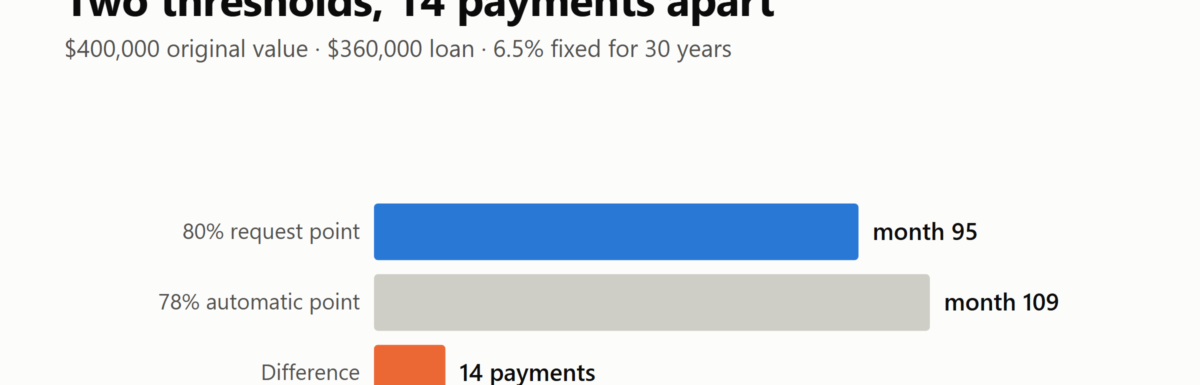
CentSheet's standard amortization calculation produces principal and interest of $2,275.44 a month. The scheduled balance first falls below $320,000 after payment 95, at approximately $319,707.73. It first falls below $312,000 after payment 109, at approximately $311,822.12.
So, under these assumptions:
- The borrower can target a written 80% cancellation request around month 95, subject to the required conditions.
- Automatic 78% termination is scheduled around month 109 if the loan is current.
- The gap is roughly 14 monthly PMI payments.
At a flat hypothetical $210 monthly premium, 14 payments are $2,940. That multiplication is only an illustration: a real PMI premium may be recalculated as the balance changes, and the precise first and last billed months come from the disclosure and servicer.
The lender's original PMI disclosure should list the first request date. Use that document and the servicer's current amortization schedule rather than rebuilding a legal cancellation date from an online calculator.
A bigger down payment is not automatically better
Putting 20% down may avoid PMI, reduce the loan, and reduce interest. It also commits more cash on closing day.
On the hypothetical $400,000 home, moving from 10% to 20% down requires another $40,000. Comparing that only with $210 monthly PMI misses:
- Principal and interest avoided on the smaller loan.
- Possible rate and PMI-pricing differences.
- Closing reserves and the emergency fund.
- The time and rent required to save the extra cash.
- Investment or other opportunity cost, which is uncertain.
The down-payment timeline owns the save-versus-buy timing question. The full homebuying budget should carry PMI as one line alongside taxes, homeowners insurance, HOA dues, repairs, and closing costs.
What to actually do
- Identify the loan type. Conventional PMI, FHA MIP, VA fees, USDA fees, and lender-paid insurance follow different rules.
- Use an actual written quote. Apply its annual percentage or stated monthly amount to the disclosed loan—not a generic average.
- Check both disclosure pages. Monthly PMI belongs in Projected Payments; upfront PMI appears in section B.
- Compare several holding periods. Upfront and lender-paid structures can look cheaper or dearer depending on when the loan ends.
- Find “original value.” For a purchase it is generally the lower of price or appraisal; after refinance, generally the refinance appraisal.
- Calendar the 80% request date. Keep the original PMI disclosure and send the request in writing.
- Check the conditions before paying for an appraisal. Confirm payment-history, current-status, junior-lien, valuation, investor, and servicer requirements.
- Watch the 78% scheduled date. If the loan is current and covered, follow up when the automatic removal should occur.
- Ask about current-value cancellation separately. Appreciation may help under investor rules, not by rewriting the HPA's original-value formula.
- Audit the next statement. Verify both the PMI line and total mortgage payment change after approved termination.
PMI is neither a penalty nor homeowner protection. It is the price of transferring part of a low-down-payment lender's risk. Calculate it from the quote, know which insurance program you have, and keep the cancellation dates before the monthly charge becomes invisible.
CentSheet publishes educational content, not personalized financial advice. This article is not legal, lending, or insurance advice. PMI cost, eligibility, billing, and cancellation depend on the mortgage, insurer, investor, servicer, payment history, and current law; verify the written terms before acting.
Get the CentSheet Money Brief
Email me CentSheet weekly: practical money decisions, new calculators, and useful worksheets. Unsubscribe anytime.