Debt-to-income ratio, or DTI, is required monthly debt divided by gross monthly income. Multiply the result by 100 to express it as a percentage.
DTI = monthly debt payments ÷ gross monthly income × 100
That formula is simple. Choosing the numerator and denominator is not. A mortgage lender may substitute a proposed housing payment for current rent, assign a qualifying payment to a deferred student loan, average variable income, or include an obligation a personal calculator missed.
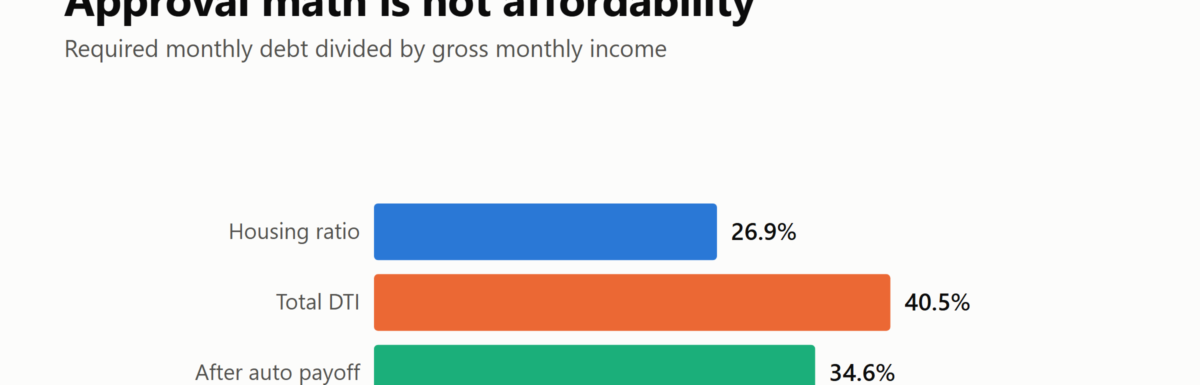
In the worked mortgage example below, proposed housing alone is 26.9% of gross income. Add the car loan, student loan, credit-card minimum, and child support, and total DTI becomes 40.5%. Neither number is a universal pass or fail. The CFPB's DTI explainer explicitly says different loan products and lenders have different limits.
Start with the exact formula
The numerator is a monthly payment flow, not total debt outstanding.
A $12,000 auto balance with a required $475 payment contributes $475, not $12,000. A $6,000 credit-card balance contributes the qualifying monthly payment the lender uses, not the amount charged that month and not necessarily the amount the borrower chooses to pay.
The denominator is gross monthly qualifying income—income before taxes and payroll deductions that the lender accepts and documents. It is not take-home pay.
| Input | Correct unit | Common wrong input |
|---|---|---|
| Installment debt | Required monthly payment | Outstanding balance |
| Revolving debt | Qualifying minimum payment | Last month's purchases |
| Salary | Gross monthly amount | Net deposit |
| Mortgage application | Proposed qualifying housing payment | Only current rent |
| Ratio | Monthly debt ÷ monthly gross income | Debt balance ÷ annual salary |
Use the personal calculation as a screening tool. The lender's calculation controls an application.
Convert gross income to monthly income
For stable fixed pay, monthly conversion is arithmetic:
| Pay pattern | Gross monthly conversion |
|---|---|
| Annual salary | Annual salary ÷ 12 |
| Monthly | Monthly gross pay |
| Semimonthly | Gross check × 2 |
| Biweekly | Gross check × 26 ÷ 12 |
| Weekly | Gross check × 52 ÷ 12 |
| Fixed hourly | Hourly rate × documented weekly hours × 52 ÷ 12 |
The Fannie Mae fixed-base-income guide, updated in 2026, uses those conversions for its loans. That does not make every dollar on a pay stub qualifying income.
Variable hourly earnings, overtime, bonuses, commissions, self-employment, rental income, and other uneven sources require history and stability analysis. In Fannie Mae's March 2026 base-income policy, variable base pay generally needs at least a 12-month history and is averaged differently when stable, increasing, or decreasing. Another program can apply different documentation or calculation rules.
Do not multiply the best recent check by 26 and call it annual income. A lender may use a lower average, exclude a new source, or ask whether it is likely to continue. For a household spending plan, budgeting variable income should remain more conservative still.
What normally goes into mortgage DTI
For a conventional mortgage sold to Fannie Mae, the current monthly-obligations guide, updated June 3, 2026, identifies obligations such as:
- The qualifying housing payment.
- Installment debts, including auto and personal loans.
- Student-loan payments.
- Revolving accounts and lines of credit.
- Lease payments.
- Certain alimony, child support, maintenance, and tax-installment obligations.
- Other mortgage debt, qualifying HELOC payments, and qualifying losses on rental property.
For a new principal-residence mortgage, housing is more than principal and interest. Fannie Mae's monthly housing-expense section includes principal, interest, real-estate taxes, homeowners and supplemental property insurance, mortgage insurance, association dues, subordinate financing, and other proposed housing expenses. The shorthand is often PITIA, but the last “A” can hold several assessments.
Details change the calculation:
- A lease can count even when only a few payments remain because another vehicle or housing obligation may follow.
- A short installment loan may sometimes be excluded, but can still count if it materially affects the ability to pay.
- A deferred or $0-reported student loan may receive a program-specific qualifying payment.
- A credit card without a reported minimum may receive an imputed payment.
- A debt paid by someone else may need a documented payment history before exclusion.
This is why a clean spreadsheet can disagree with underwriting without either having an arithmetic error.
What normally stays outside the ratio
Ordinary living costs are usually not monthly debt payments in a mortgage DTI numerator:
- Groceries.
- Utilities and phone service.
- Childcare.
- Health-insurance premiums and medical spending without a debt payment.
- Transportation fuel and routine maintenance.
- Retirement contributions.
- Income-tax withholding.
- Streaming and other cancelable subscriptions.
That exclusion makes DTI useful for measuring contractual debt load and incomplete for measuring affordability. Childcare can cost more than a car payment while contributing zero to formal DTI. A high-deductible health plan can create substantial cash exposure without a monthly debt until a bill is financed.
Some items move between categories. A medical installment plan is debt even though routine medical spending is not. A tax bill on an installment agreement can count even though normal withholding does not. A buy-now-pay-later obligation may be evaluated from credit reports, bank statements, or application disclosures depending on the lender and program.
Do not hide a liability because a generic calculator lacked a box. Give the lender the complete application and ask how it was treated.
Front-end versus back-end DTI
Two ratios answer different questions:
Housing ratio = proposed monthly housing expense ÷ gross monthly income
Total DTI = proposed housing + other qualifying monthly debts ÷ gross monthly income
The first is often called front-end DTI or housing-expense-to-income. The second is often called back-end or total DTI. Not every lender presents both, and underwriting emphasis varies.
Freddie Mac's housing-expense guide, effective May 6, 2026, defines its housing ratio as monthly housing expense divided by stable monthly income or a qualifying asset amount. Its separate total-DTI section adds monthly liabilities. That is a program definition, not a universal consumer standard.
A worked mortgage example
These are hypothetical inputs, not an approval scenario or national averages:
| Input | Monthly amount |
|---|---|
| Gross qualifying income | $8,000 |
| Proposed principal, interest, taxes, insurance, PMI, and HOA | $2,150 |
| Auto loan | $475 |
| Student-loan qualifying payment | $225 |
| Credit-card qualifying minimum | $90 |
| Child support continuing under the example's loan rules | $300 |
CentSheet calculations:
Housing ratio = $2,150 ÷ $8,000 = 26.875%, rounded to 26.9%
Total monthly obligations = $2,150 + $475 + $225 + $90 + $300 = $3,240
Total DTI = $3,240 ÷ $8,000 = 40.5%
Now add costs that formal DTI may ignore: $1,200 childcare, $800 groceries, $300 utilities and phone, $250 transportation operating costs, and $400 retirement saving. They do not change the 40.5% lender ratio in this illustration. They reduce available household cash by $2,950 a month.
That is why “the lender approved it” cannot replace budgeting for the full cost of buying a house.
There is no universal good DTI
The number circulating online is often a real rule detached from its program, underwriting method, or exception.
For example, Fannie Mae's DTI guide, dated April 2, 2025 and current when checked August 14, 2026, states a 36% maximum for its manually underwritten loans, with an increase up to 45% when specified credit-score and reserve requirements are met. That sentence does not describe every Fannie Mae loan, every automated decision, FHA, VA, USDA, a portfolio lender, or a non-mortgage product.
Even within one application, rate, down payment, reserves, loan term, property taxes, mortgage insurance, HOA dues, and an underwriting-system result can change the decision. DTI is one variable, not a public approval promise.
Nor is a lower ratio always safer in isolation. A household may have no reported debt and no emergency cash. Another may have a moderate DTI, substantial reserves, and stable income. Underwriting and personal affordability both use more than one number.
How paying debt changes DTI
Reducing a balance helps DTI only when it reduces or removes the monthly payment the lender uses.
Paying $2,000 toward a credit card may lower the required minimum, but the exact qualifying payment depends on the next statement and program. Paying an installment loan from $10,000 to $8,000 may leave the scheduled $475 unchanged and therefore leave DTI unchanged. Paying it off can remove $475, subject to documentation and program rules.
In the worked example, eliminating the $475 auto payment changes total obligations from $3,240 to $2,765:
Revised DTI = $2,765 ÷ $8,000 = 34.6%, rounded from 34.5625%
But spending every dollar of the house down-payment fund to remove the car loan may reduce reserves or down payment and change the mortgage elsewhere. Optimize the whole file, not one ratio.
Credit score is separate. It can affect pricing and eligibility without appearing in the DTI formula; current mortgage-score mechanics are covered in credit score to buy a house.
What to actually do
- List required monthly payments, not balances. Use current statements, court orders, leases, and payoff terms.
- Build the proposed housing payment completely. Include principal, interest, property tax, homeowners insurance, mortgage insurance, association dues, and subordinate financing.
- Convert gross income using the actual schedule. Biweekly means 26 checks, not two checks every month.
- Separate fixed from variable income. Ask what history and averaging the intended loan program requires.
- Calculate both ratios. Housing-only shows the new home burden; total DTI adds other qualifying obligations.
- Do not apply a universal cutoff. Ask the lender which program, underwriting method, and qualifying payments produced its number.
- Run a net-income budget beside DTI. Put childcare, food, utilities, saving, repairs, and health costs back into the budget calculator.
- Before paying debt for qualification, ask what changes. Confirm whether the payment will be reduced or excluded and what documentation is required.
- Recalculate before closing. New debt, a changed rate, updated taxes, insurance, HOA dues, or lower verified income can move the ratio.
DTI is a lender's view of monthly contracts against gross qualifying income. Calculate it cleanly, but never mistake a ratio that excludes groceries, childcare, taxes, and repairs for a complete measure of what a household can afford.
CentSheet publishes educational content, not personalized financial advice. This article is not a loan offer or approval guideline. Lenders, loan programs, and underwriting methods calculate qualifying income and obligations differently; verify the current calculation with the lender handling the application.
Get the CentSheet Money Brief
Email me CentSheet weekly: practical money decisions, new calculators, and useful worksheets. Unsubscribe anytime.