Use checking for money expected to move this pay cycle. Use savings for money that should survive it.
That division is more useful than “checking spends, savings earns.” Some checking accounts pay interest. Some savings accounts allow fast transfers. Either can have fees. The practical difference is the job you assign each account and the contract governing access.
A checking account should absorb direct deposits, bill payments, debit-card spending, checks, and a buffer for timing errors. A savings account should isolate an emergency reserve and money for dated goals, usually while earning a stated annual percentage yield.
| Feature | Checking account | Savings account |
|---|---|---|
| Primary job | Transactions | Reserves and goals |
| Common access | Debit card, checks, ACH, bill pay, ATM | Transfers, ACH, ATM depending on account |
| Interest | May pay none or a stated APY | Commonly pays a stated APY |
| Main fee risks | Maintenance, ATM, overdraft, checks | Maintenance, minimum balance, transfer or excess-withdrawal terms |
| Best balance | Near-term outflows plus buffer | Money not assigned to this spending cycle |
You do not need two different institutions. You do need two clearly different jobs.
Checking is the transaction account
Checking is built around frequent movement. It commonly receives payroll, sends rent or mortgage payments, pays cards and utilities, supports checks and bill pay, and connects to a debit card.
The amount to keep there is not “as little as possible.” It is:
Known outflows before the next deposit + planned variable spending + checking buffer
The buffer covers timing rather than lifestyle: a utility bill posting one day before payroll, a restaurant tip settling above its authorization, or two annual charges arriving together. It is not permission to spend to zero.
Checking can pay interest, but compare the whole fee structure. The CFPB's guidance on interest-bearing checking warns that higher fees or balance requirements can outweigh the interest earned. A 0.10 percentage-point yield advantage is worth only $5 a year on an average $5,000 balance before tax. One avoidable fee can erase it.
That $5 is a CentSheet calculation: $5,000 × 0.001 = $5. It assumes the balance remains $5,000 for a year and ignores compounding and tax. Use the account's APY and actual average balance for a real comparison; our APR-versus-APY guide explains the rate language.
Savings is a boundary around future money
Savings is for cash that has a purpose beyond the current spending cycle:
- The first layer of an emergency fund
- A deductible or repair reserve
- A down payment or moving fund
- Annual insurance, tuition, or tax bills
- A vacation or replacement-car target
Separating that money reduces accidental spending and makes the amount available for each goal visible. The account does not make the plan; the label and transfer rule do.
Savings can be highly liquid, but not every product called “savings” behaves the same way. Check ACH timing, ATM access, withdrawal limits, minimum balances, maintenance fees, and whether transfers to checking are instant only inside the same institution.
For emergency money, yield is only one variable. Deposit insurance, access during an outage, transfer speed, and account holds matter too. Our guide to where an emergency fund belongs separates immediate cash from money that can wait several days.
Do not use a certificate of deposit, investment account, or money-market mutual fund as though each were simply another savings account. Their access, price, and insurance can differ.
Interest and fees must be read together
Regulation DD, the federal Truth in Savings rule, requires covered institutions to disclose APY, interest rate, minimum-balance requirements, and fee schedules for deposit accounts. Use those disclosures to compare the account you will actually operate.
For checking, inspect:
- Monthly maintenance fee and waiver conditions
- Minimum balance and how it is measured
- In-network and out-of-network ATM fees
- Overdraft and nonsufficient-funds policies
- Check, wire, stop-payment, and replacement-card fees
- Direct-deposit requirements
For savings, inspect:
- APY and whether it applies to the full balance
- Tiered rates or balance caps
- Monthly fee and minimum balance
- Transfer and withdrawal rules
- Time required to move money externally
- Limits on linked accounts
“Free checking” has a specific advertising meaning. The CFPB says an account described as free or no-cost cannot impose a monthly service fee, a minimum-balance fee, or a fee merely for depositing, withdrawing, or transferring money. It can still charge particular fees such as out-of-network ATM, overdraft, stop-payment, dormant-account, or check-printing fees. Free does not mean every possible service costs zero.
A bank bonus also can distort the choice. Meet the requirements only if the account remains useful after the bonus and the required deposit does not disrupt the rest of the plan. Our bank-account bonus analysis shows why a high-looking return can come with operational work.
Deposit insurance aggregates accounts
Checking and savings deposits at an FDIC-insured bank are generally covered deposit products. As of August 14, 2026, the FDIC standard insurance amount is $250,000 per depositor, per insured bank, per ownership category.
The last phrase matters. A $200,000 single-owner checking account and a $100,000 single-owner savings account at the same bank are not each separately insured to $250,000. They are combined within the same single-account ownership category: $300,000 total, of which $250,000 is within the standard limit and $50,000 is above it, assuming no other facts change coverage.
That is a CentSheet application of the FDIC rule, not an insurance determination. Joint accounts, trusts, retirement deposits, beneficiaries, bank networks, and account titling can change coverage. Use the FDIC's official estimator or contact the agency for a specific structure.
Federally insured credit unions use NCUA share insurance rather than FDIC insurance. The NCUA's share-insurance FAQ explains a similar $250,000 framework by owner and ownership category. Confirm that the institution—not merely an app interface—is federally insured, and identify which bank or credit union legally holds the deposit.
Deposit insurance protects covered deposits if an insured institution fails. It does not make every payment app, investment, cryptocurrency, or money-market mutual fund a covered deposit, and it does not replace fraud controls on the account.
The federal six-transfer rule is gone; account terms are not
Advice that every savings account allows only six transfers a month is outdated as a federal requirement.
On April 24, 2020, the Federal Reserve amended Regulation D to delete the six-per-month limit on convenient transfers from savings deposits. The Fed's current Savings Deposits FAQ, reviewed for this article on August 14, 2026, says the change permits institutions to suspend the limit but does not require them to do so.
A bank or credit union may therefore retain contractual withdrawal limits, charge a disclosed fee, restrict certain transaction types, or require notice under its account terms. The federal rule's deletion did not rewrite every deposit agreement.
This leads to a useful design principle: do not operate savings as a second checking account. Make one or two planned transfers, not dozens of reactive rescues. If constant transfers are necessary, the checking target or spending plan is probably too small.
Overdraft is a checking design problem first
An overdraft occurs when a transaction exceeds available checking funds and the institution pays it anyway. A linked savings account may transfer money to cover the gap, sometimes for a fee. That can be cheaper than standard overdraft coverage, but the account agreement controls.
Under Regulation E, an institution generally cannot charge an overdraft fee for an ATM or one-time debit-card transaction unless the consumer affirmatively opts in. The CFPB's overdraft-fee guidance notes that checks and recurring electronic payments can still create overdraft or returned-item consequences even without that debit-card opt-in.
Declining debit-card overdraft does not guarantee that every attempted payment will be harmlessly declined. A check, ACH debit, recurring bill, or merchant fee can behave differently. Read the policy and build a buffer.
Our fuller overdraft protection analysis explains why the fee can be disproportionate to a small shortage. The cleaner fix is to reduce timing collisions before buying protection from them.
A two-account operating system
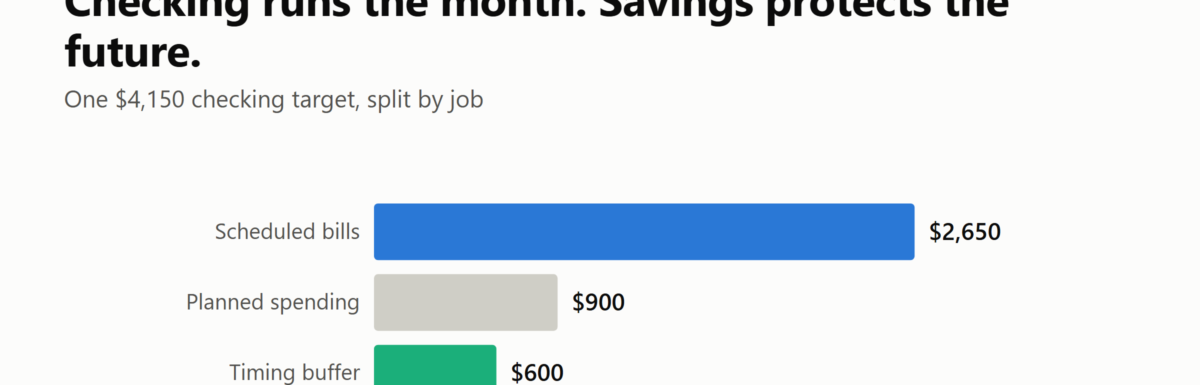
Suppose a household receives $4,200 monthly after tax. It expects:
- $2,650 of scheduled bills
- $900 of planned variable spending from checking
- A $600 checking buffer
Its operating target is $4,150:
$2,650 + $900 + $600 = $4,150
That is a CentSheet example, not a recommended universal buffer. If the checking balance after payday is $4,700, the household could move $550 to savings while retaining the modeled operating target. If some bills land after another paycheck, calculate by pay period rather than leaving a full month's outflows at once.
The system becomes:
- Income lands in checking.
- Bills and planned spending leave checking.
- A fixed floor remains untouched.
- Money above the operating target moves to named savings goals.
- A savings withdrawal requires a named reason, not merely a low checking balance.
Automating the transfer a day after payroll is useful only after the bill calendar is correct. An automation that empties checking before rent is not saving; it is a timing error.
When more accounts help—and when they do not
Separate savings accounts can make goals visible: emergency reserve, annual bills, travel, home repair. They can also multiply passwords, minimum balances, tax forms, transfer delays, and opportunities to miss fraud.
Add an account only if it creates a distinct rule that one account cannot handle with labeled subaccounts or a spreadsheet. Three savings buckets at one insured institution do not triple FDIC coverage when they share the same ownership category.
For couples, the choice also includes ownership and access. One joint checking account plus separate personal spending accounts can work; so can mostly separate accounts with a joint bills account. The right structure depends on transparency, legal ownership, safety, and administration. See our joint-versus-separate account guide for that decision.
The simplest workable system wins. Account count is not financial progress; funded goals and avoided fees are.
What to actually do
- List every deposit, bill, debit-card purchase, check, and transfer expected before the next payday.
- Set a checking operating target equal to those outflows plus a deliberate timing buffer.
- Put emergency cash and dated goals in savings, with labels and withdrawal rules.
- Compare APY only after maintenance, minimum-balance, ATM, overdraft, and transfer terms.
- Confirm FDIC or NCUA insurance and aggregate all deposits at the same institution by ownership category.
- Read the current savings withdrawal policy; do not assume the old federal six-transfer rule still applies or that the bank removed its own limit.
- Review overdraft opt-in choices and test how linked savings protection works.
- Add another account only when it creates a useful boundary that outweighs the complexity.
CentSheet publishes educational content, not personalized financial or legal advice. Account access, APYs, fees, overdraft treatment, insurance coverage, holds, and transfer limits vary by institution, ownership, and product. Verify current disclosures and insurance status with the bank, credit union, FDIC, or NCUA. Examples are mathematical illustrations based on stated assumptions.
Get the CentSheet Money Brief
Email me CentSheet weekly: practical money decisions, new calculators, and useful worksheets. Unsubscribe anytime.